



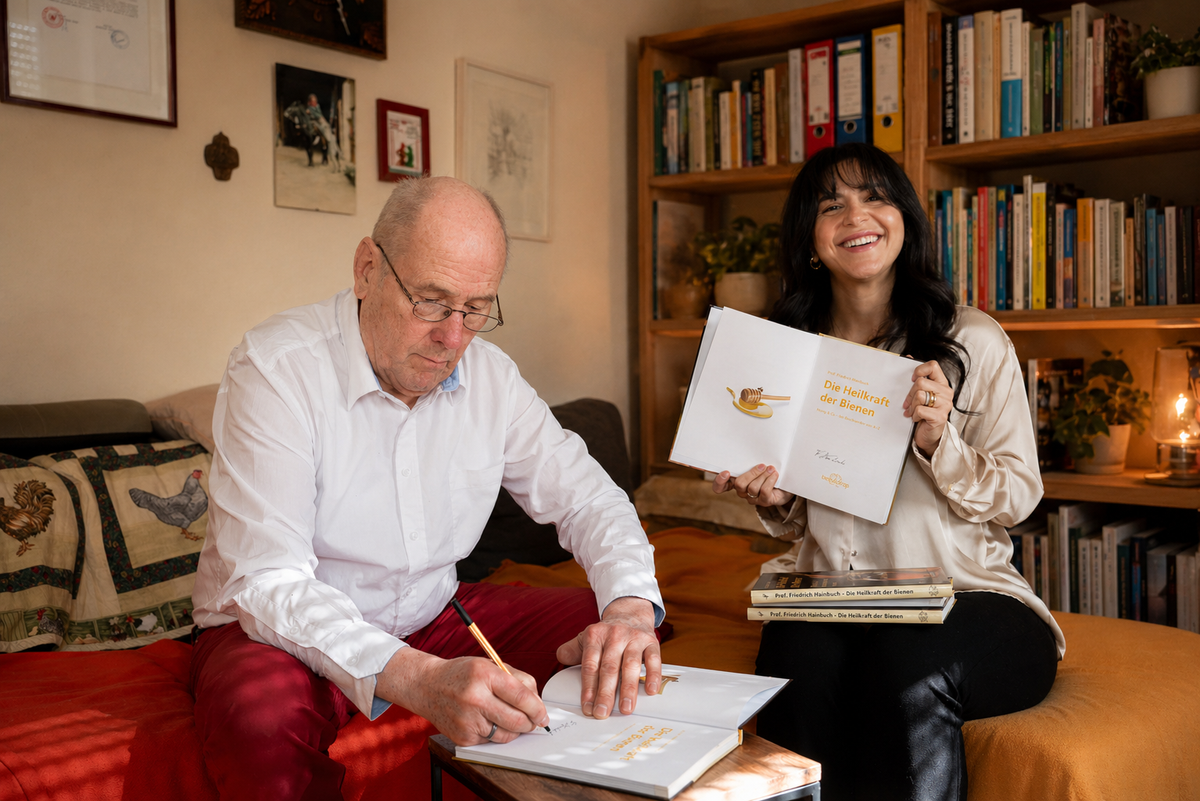

At bedrop, everything has revolved around the world of bees and their precious treasures for years. Sometimes, in the course of this work, you meet people whose experience simply leaves you in awe. People who speak with calm, matter-of-fact ease about things that others would spend a lifetime researching. We had the privilege of spending an afternoon like this with Prof. Dr. Friedrich Hainbuch—a scientist, passionate beekeeper, and author of the book *The Healing Power of Bees*. What began as an interview quickly turned into a conversation that stayed with us long afterward.
From the Lecture Hall to the Beehive
Prof. Dr. Hainbuch, born in 1953, has led an unusually multifaceted life. He holds three doctorates—in theology, sports science, and medicine. Before devoting himself entirely to apitherapy, he spent about twenty years as a religion teacher in the public school system. Today, he teaches as an associate professor at the University of Oradea in Romania. What really impressed us: Despite all his degrees and books, he has simply stayed close to the bees. On his old farm, he tends to six of his own bee colonies. In the spring and summer, he extracts his honey with his own hands.
The turning point in his relationship with bees came with the news about the global bee die-off. “Reading about it” turned into “doing something.” On his farm, he not only gave the bees a home, but also horses, dogs, cats, and—in collaboration with NABU, one of Germany’s largest nature conservation organizations—even an endangered barn owl.
What resonated most with us was the calm and depth with which he speaks about bees. As a naturopath, he has been studying the use of bee products for many years and incorporates them into his work with patients. Apitherapy—the use of bee products to support well-being—is not a trend to him, but rather millennia-old knowledge waiting to be rediscovered. It is a tradition that was already practiced in ancient Egypt and is still upheld today in Central and Eastern Europe, Asia, and the Americas.
While apitherapy is still somewhat of a niche topic in Germany, it has long been part of everyday complementary medicine in countries such as Romania, Russia, and China. Hainbuch has made it his mission to raise awareness of this knowledge here in Germany as well. The depth of his connection to this subject is also evident on the international stage: the Apitherapy Section of the Slovenian Beekeepers’ Association has named him an honorary member and awarded him a plaque for outstanding contributions to apitherapy.
What We Took Away from the Conversation
We had brought many questions with us—about honey, propolis, and royal jelly; about what bees give us; and about what people have made of these gifts over the centuries. Prof. Dr. Hainbuch took his time and answered with surprising candor.
“Manuka honey should be a staple in every home medicine cabinet.”
It’s statements like this that stick with you. Not because they’re well-worded, but because they’re backed by decades of practice, research, and lived experience. It’s precisely this combination that makes all the difference.
Practical knowledge about bees, explained simply

“The Healing Power of Bees” is just one of several books Prof. Dr. Hainbuch has written about the world of bees. It takes you into the world he describes so vividly in conversation. Across 144 pages, he describes the special treasures of the beehive: honey, propolis, royal jelly, bee pollen, and much more. And he shows how you can integrate this knowledge into your everyday life in very concrete ways.
The best part: It’s not a dry textbook. Inside, you’ll find recipes from ancient Egypt, tips from modern apitherapy, and knowledge that has been passed down for generations. Easy for anyone to understand, even without any specialized knowledge. A book that brings science and practical living together.
More Attention for Bees
What we take away from the conversation goes beyond application and effects. Prof. Dr. Hainbuch reminded us how closely our well-being is linked to that of the bees. Without bees, there is no honey, no pollination, and no healthy ecosystem.
The breadth of his commitment is also evident in his other books. In “The Silent Death of the Bees,” he shows just how much of our own lives depend on bees. And it is precisely this clarity that has once again made us aware of our own responsibility.
After this meeting, we were left with a sense of having met someone who has never lost his enthusiasm. And that is exactly what we take with us: A quiet, sincere connection to the world of bees that lingers long after. And it is precisely this thought that guides us in our own work. It reinforces our sense of purpose and makes us proud of what we do every day at bedrop.
Interview with Bee &Prof. Dr. Hainbuch