





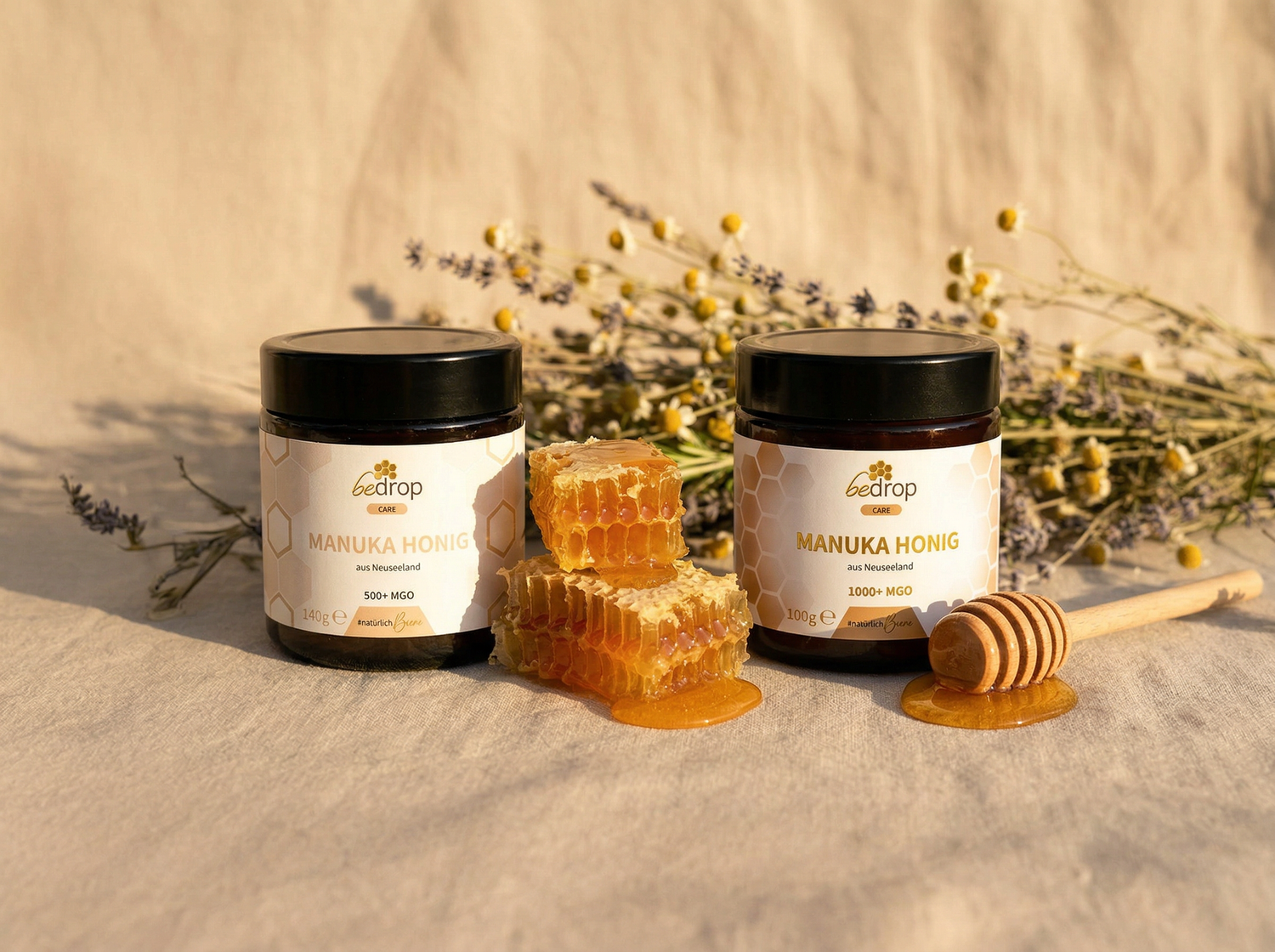

Why take MGO 500+ when there is also MGO 1000+? Sounds logical at first. But it's not quite that simple. Because each MGO content has its own strengths and its own place in everyday life. More is not automatically better, but different.
Both come from the same natural regions of New Zealand, both are certified and laboratory-tested, and both are real Manuka honey as it should be. What sets them apart is not quality, but concentration, application and how you want to integrate Manuka honey into your everyday life.
In this article, we'll explain what's behind both, explain the MGO comparison and help you make the right choice.
First things first: what is MGO anyway?
MGO stands for methylglyoxal, a substance that is only found in significant quantities in Manuka honey. It is produced during the natural ripening process in the honeycomb: The nectar of the Manuka plant initially contains dihydroxyacetone, which is converted to methylglyoxal as the honey matures. Depending on the concentration, this process takes up to 18 months. It is still not fully understood why this substance is found exclusively in the nectar of the manuka plant. It is therefore produced all by itself, without anything being added or changed afterwards. The number on the jar indicates how much methylglyoxal is contained per kilogram of honey.
For comparison: A normal blossom honey contains just 1 to 10 mg MGO per kilogram. Our Manuka honeys start where others stop. The higher the MGO value, the more concentrated the honey is in this particular ingredient. This does not mean that a lower value is bad, but that each level brings its own character and strength.
An MGO 100+ is ideal for daily consumption, while higher values such as MGO 400+ or 800+ are deliberately chosen by many customers if they want to focus on a higher concentration.
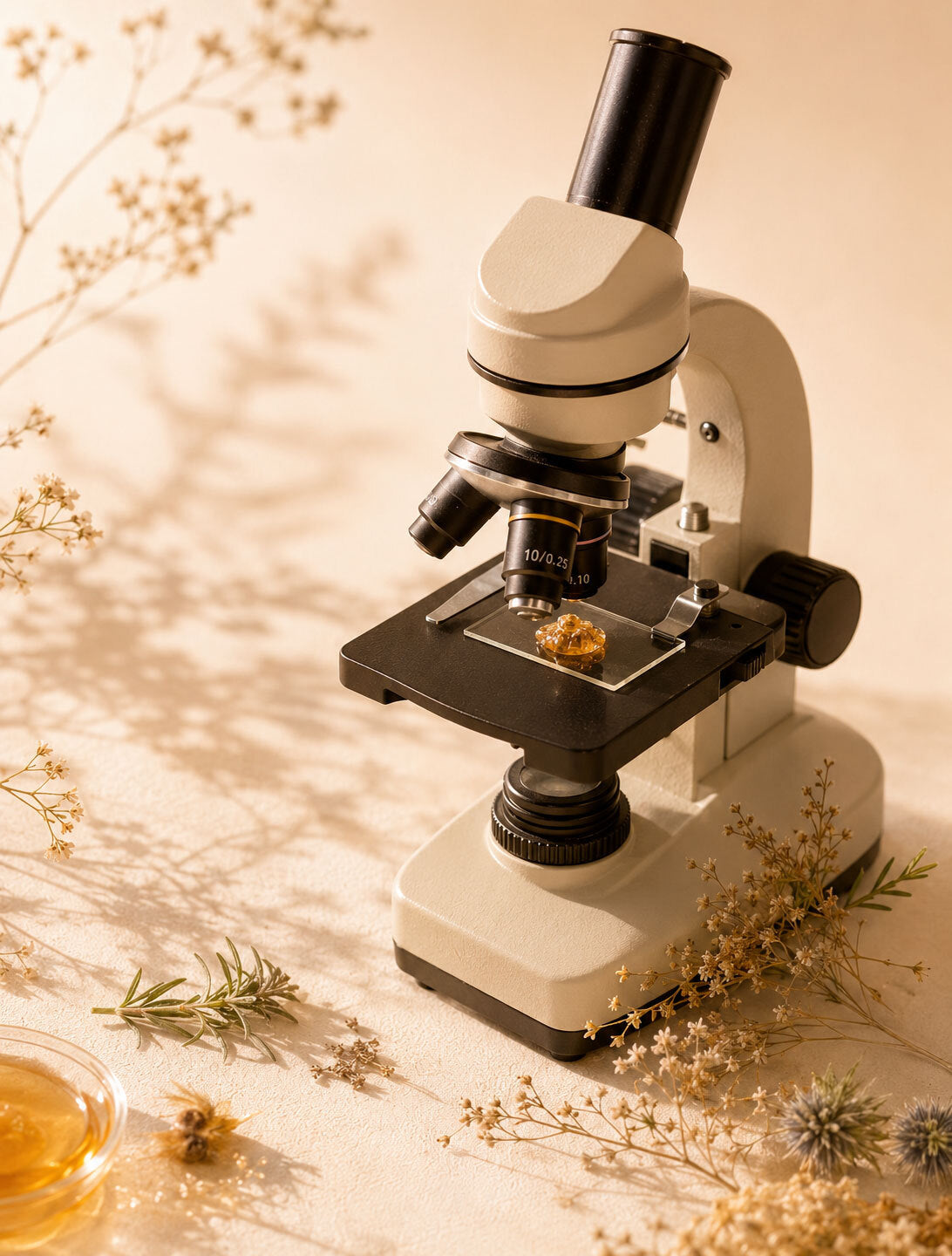
Important to know: Because real Manuka honey is so sought after, counterfeits are not uncommon on the market. Significantly more "Manuka honey" is sold worldwide than is actually harvested in New Zealand. That is why each of our batches is analyzed and tested in independent, accredited laboratories in both New Zealand and Germany, so that you can be sure that your jar contains exactly what it says on the tin.

Manuka honey MGO 500+: the reliable companion
Our MGO 500+ is the Manuka honey that most of our customers integrate into their daily routine. A teaspoon pure in the morning, in tea or on breakfast. It's there when you need it.
Its taste is full of character, but accessible: slightly earthy, with a mild, round sweetness that clearly stands out from ordinary blossom honey. Those who try Manuka honey for the first time usually start here and stick with it.
The MGO 500+ is available all year round because many harvests in New Zealand regularly reach this concentration range. This makes it the ideal starting point and a reliable everyday honey for the whole family. Used internally pure or in tea, externally as a nourishing additive in body care: it is versatile, economical and sustainably packaged in jars. It is not without reason that our customers reach for this honey time and time again.
Manuka honey MGO 1000+: Rare starch from the honeycomb
An MGO content of over 1,000 is considered exceptionally high. Less than one percent of the world's annual Manuka production reaches this concentration. Like all our manuka honeys, the MGO 1000+ comes from natural regions of the North Island of New Zealand such as Manawatu-Whanganui, Northland, Waikato and Taranaki, where honey bees (Apis mellifera) collect the nectar of the manuka plant.
The taste is more intense than the MGO 500+: more complex, deeper, with a surprising strength of character. The texture is denser, more matte, creamier. When you open it for the first time, you immediately notice the difference.
This honey unfolds its character best pure on a spoon , especially in the morning. Usually half a teaspoon a day is all you need. If you include the portion size, you will notice that the price difference is quickly put into perspective.
Its high concentration is the result of a particularly long maturing period of around 18 months in the honeycomb. This makes it something special, not something better.
We have currently launched the MGO 1000+ as a limited edition: exactly 5,000 jars, not one more. If you think about it too long, you're looking at an empty display case. And when will the next harvest reach this concentration? That's for the bees to decide.
The honest answer: Which one is right for you?

Go for MGO 500+ if you want to use Manuka honey every day, like a reliable supply, want to provide for the whole family or are trying Manuka honey for the first time.
The MGO 1000+ is your choice if you know what Manuka honey is and want to consciously choose a particularly high MGO concentration.
In the end, it's a personal choice. There is no right or wrong, only what suits you and your everyday life. Some people start with MGO 500+ and stick with it, others combine the two depending on the situation. Both are just right.
What they both have in common: They come from the North Island of New Zealand, are collected by honeybees carrying the nectar of the manuka plant, and are traceable back to the beekeeper. Each batch is double lab tested and free from additives, sustainably packaged in glass. And with every purchase you support our nature conservation project, a 5,000 m² flowering meadow that creates a permanent habitat for wild bees and many other animal species.
Which one suits you?
To Manuka honey MGO 500+
To the Manuka honey MGO 1000+ (limited)